When insurance becomes the barrier to owning a home
The intrinsic link between homeownership and insurance
December 16, 2025
The New Pressure on Homeownership
Every week, another article appears about rising insurance premiums. And almost every time the story ends the same way: acceptance.
Homeowners are paying more. Coverage is shrinking. Premiums are rising and we are told (implicitly or explicitly) that this is simply the new normal. It has made one thing unmistakably clear: insurance is the next major barrier to stable homeownership.
Homeowners are being pushed into higher deductibles just to keep their policies and communities exposed to extreme weather events are losing coverage altogether.
“In many wildfire exposed communities, homeowners are losing coverage entirely because insurers cannot quantify the risk,” reports Headwaters Economics. Even carriers themselves now acknowledge that traditional risk models are no longer enough.
We have already lived through a supply crisis. We are still navigating a challenging mortgage-rate environment.
Now a third pressure is emerging, and it is becoming one of the most significant threats to affordability: insurance.
We simply cannot talk about the future of homeownership without talking about the future of insurance. But acceptance does not have to be the only answer.
A System That Has Not Kept Up
“The United States now faces a billion dollar weather disaster every three weeks, a pace that is reshaping the economics of insurance,” according to Bloomberg. Storms are more frequent, more severe, and more difficult to model; yet the aerial imagery needed to understand that risk is often outdated or incomplete.
It boggles my mind that we’re relying on a 1950s Earth imagery playbook to understand 21st century climate risk. Storms are becoming more frequent, more severe and harder to model, yet the data behind many underwriting decisions remains outdated, incomplete or both.
Most aerial imagery today comes from aircraft flying slow, expensive lawnmower patterns; and satellites, although global, cannot deliver the resolution, timing, or flexibility needed in a world increasingly shaped by rising climate volatility. And sure, drones help at the hyper-local level, but they do not scale. In fact, it would take 800k drones to cover New York City.
That lack of detail matters: when insurers cannot see risk clearly, they price for uncertainty. And that uncertainty shows up as higher premiums, higher deductibles, or, worst of all, losing access to coverage altogether.
As Realtor.com notes, “More homeowners are being pushed into higher deductibles simply to keep their insurance at all.”
Why Better Data Matters
Homeowners are being asked to absorb more risk because the system is limited by the data behind it. Better information can change that, and quickly.
We’ve seen the impact firsthand.
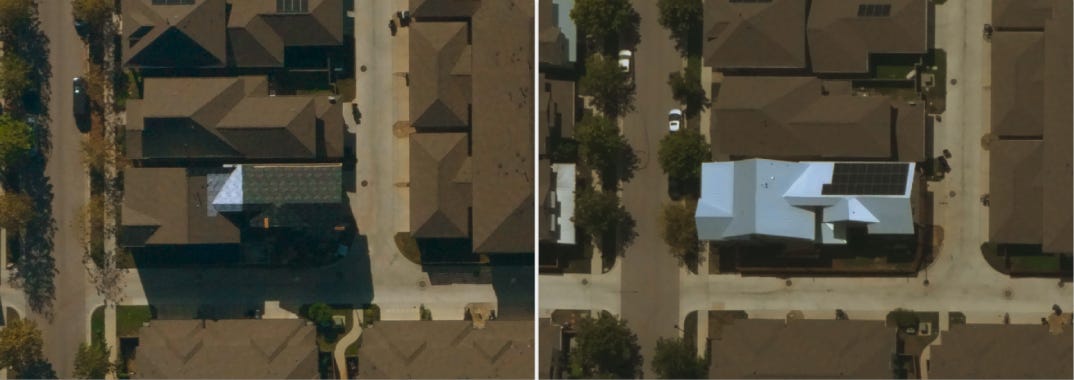
At Near Space Labs, we’re not treating rising insurance costs as inevitable. We’re addressing one of the root causes: outdated and incomplete visibility into how communities are actually changing. Our high-frequency, wide-scale imagery allows insurers to evaluate homes based on current conditions, not assumptions
And, we’re doing so across the continental United States right now. Like I said above…what takes 800k drones in NYC, would take us a single flight! With our data, insurers can see how risk shifts month to month and evaluate homes based on their actual condition rather than assumptions. The result is pricing that becomes more accurate and coverage that becomes more reliable.
Clarity replaces guesswork.
Visibility replaces uncertainty.
What Homeowners Deserve
A home should be a source of stability because it’s a core pillar of climate resilience, the right to shelter. Homeowners deserve confidence that their insurance reflects the world as it is today, not as it was 75 years ago. Better clarity leads directly to better protection; for families, neighborhoods, and entire communities.
When risk is understood, homeownership stays possible. Clarity is not a luxury, it is the only path forward.